
"We're Trading Them Like Baseball Cards": Mark Cuban on the AI Bubble, and What It Means for the Data Centers Coming to the Valley
$800 billion. That is how much the five largest tech companies are expected to spend on capital projects this year, mostly on AI, according to Nvidia management. $1.3 trillion is the projection for 2027. $225 billion in bonds had already been issued by hyperscalers and related companies by late July, according to S&P Global data reported by Fortune.
$4 billion of that kind of money is now moving dirt in Cameron County.
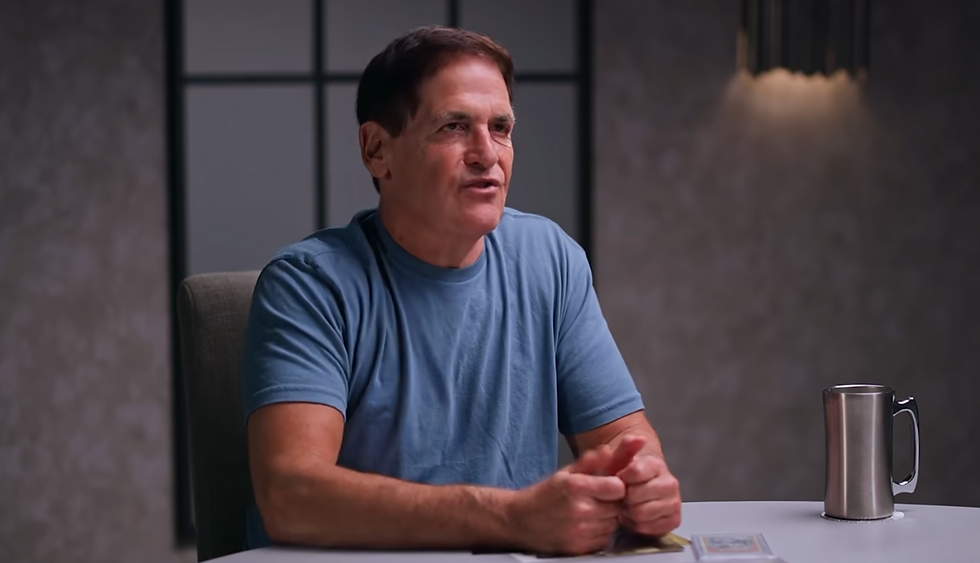
Billionaire investor Mark Cuban thinks the market around all of this is in a bubble. He said so plainly in an interview with Steven Bartlett on "The Diary of a CEO," released Oct. 26.
"I think we're in a bubble, but not the same as the internet bubble back in 2000, 2001," Cuban said.
His argument is worth hearing in full, because the Rio Grande Valley is no longer watching the AI boom from a distance. It is becoming part of the physical infrastructure of it.

THE BUBBLE IS IN HOW STOCKS TRADE
Cuban's bubble is not the classic story of companies with no revenue. His case is about behavior.
"I think what's different now is everything's a meme stock," he said. "Bitcoin is a meme stock, right? Micron, Google, Apple, they're meme stocks."
His evidence is how violently stock prices react to small news.
"A company might miss earnings by a penny or only beat by a penny and their stock will be down 18%," Cuban said. "The intrinsic value of that company hasn't changed 18%."
What changed, in his view, is that buyers and sellers now move on anticipated information rather than on what a company will actually earn over time.
"We're trading them like baseball cards," he said. "There's no intrinsic value to this. It's just perceived value and what you think somebody else will pay for it. And I think we're in a bubble for that very reason."
Asked what would cause it to burst, Cuban did not pretend to know.
"I have no idea," he said.
BUBBLES STILL PRODUCE WINNERS
Cuban was clear that a bubble does not mean the technology is fake. He pointed to the dot-com crash, which he lived through after selling Broadcast.com.
"Look at Dell and Amazon," he said. "They were companies whose stocks went from way up high, got crushed when the internet bubble burst. Amazon was losing money hand over foot." Today, he noted, Amazon is worth trillions.
"So there will be winners," Cuban said. "I just don't know which company. Is it Anthropic? Is it OpenAI? I don't know."
He also rejected the idea that he is an AI skeptic. "I'm not a naysayer on AI. I am the biggest proponent of AI that there is," he said. "But in order to really get the benefit, you have to be honest about it."
"AI IS NOT SMART"
Cuban's market view rests on a technical one. He believes the industry is paying for intelligence with raw horsepower.
"AI is not smart. It just knows how to use statistics basically to predict the next word," he said. "It's predictive. It's not deterministic."
His test for when AI would truly be smart is efficiency: a system that can solve problems with minimal resources, the way a brilliant kid with no advantages figures things out. He does not think the current path gets there.
"You have to have more power and more GPUs than the history of power and GPUs prior to last year," Cuban said. "That's not intelligence. There's a reason why you have to have all that. It's just brute force."
That point is where his view of AI connects directly to buildings, power lines and debt.
THE PICKLEBALL COURT WARNING
Cuban repeated a line he first used on the "All-In" podcast this summer: many data centers could end up as pickleball courts.
"As a metaphor, not that literally they'd be pickleball courts," he clarified on "The Diary of a CEO." "Because in order for AI to reach the pinnacle that everybody wants to reach, you have to have less power doing more, not more power doing more. Because then you run into constraints like we're running into right now."
Put simply: if someone builds AI that does the same work with far less electricity and far fewer chips, a lot of the giant facilities under construction today would no longer be needed at the scale they were built for.
That is a prediction, not a fact. But it is a prediction from someone who watched fiber networks get overbuilt in the 1990s and then sit dark after the crash.
THE DEBT BUBBLE
The most significant market warning in the interview was not about stock prices. It was about borrowing.
"We literally could get into a debt bubble in the United States of America because there's so much debt being taken out by all these hyperscalers," Cuban said.
His reasoning ties corporate borrowing to federal borrowing. The federal deficit keeps rising, so the government borrows more. At the same time, he said, the hyperscalers "are borrowing more than they're making," and lenders are competing for that business.
"Rates keep on going up," Cuban said. "If you've got a $40 billion debt and your interest rate keeps on going up, at some point you can't raise money anymore. There's a lot of praying going on right now."
He singled out Nvidia, which he praised, as a company propping up its own customers. "I'm a huge fan of Nvidia and Jensen Huang, but they're basically subsidizing half the industry because they have the cash to do it," he said.
That claim has some support in Nvidia's own disclosures. According to figures from Nvidia's earnings call reported by 24/7 Wall St., the company has invested nearly $50 billion in frontier AI labs and has announced partnerships to raise more than $500 billion in third-party capital, with guarantee obligations capped at $108.5 billion.
Cuban also said Meta is borrowing more than it generates in cash flow, though he hesitated on which company he meant and did not give a figure. That specific claim should be treated as his characterization, not an established fact.
"Until then we're in this private credit debt environment where there's a lot of uncertainty and a lot of things can go wrong," Cuban said, citing investor Ray Dalio's warnings about U.S. debt levels.
WHAT THIS HAS TO DO WITH THE VALLEY
Everything Cuban described now has addresses in Cameron County. Two companies have put data center plans for Cameron County on the public record, and a third possible project near Starbase is drawing attention.
Together, the two public proposals alone add up to as much as 3.5 gigawatts of planned capacity and more than $18 billion in stated investment. That is the scale of bet Cuban is warning about.

PROJECT 1: FLUIDSTACK, NEAR RIO HONDO
Status: Under construction.
Fluidstack, an AI cloud company, began site work in September on a $4 billion first phase of an AI data center campus along FM 106, east of Valley International Airport and west of the Port of Harlingen. The company says the first phase is planned to support up to 1.5 gigawatts of capacity on more than 1,000 acres. Its project website targets mid-2028 for completion.
Here is what Fluidstack has said publicly:
It expects more than 2,500 construction jobs and several hundred permanent jobs.
It says it requested and received no local property tax abatements and will pay full local property taxes.
It says cooling will run on a closed-loop system supplied by East Rio Hondo Water Supply Corporation.
It says it will pay for its own energy and infrastructure, and its project website says it is developing on-site generation to reduce demand on the ERCOT grid.
Here is what it has not said publicly:
It has not named a customer for the campus.
It has not detailed how the first phase is being financed.
It has not publicly specified what fuels its on-site power generation.
Anthropic, one of the companies Cuban named as a possible AI winner, announced in November 2025 a $50 billion U.S. computing infrastructure investment that includes custom data centers built with Fluidstack in Texas and New York. Whether the Cameron County campus is one of those sites has not been publicly confirmed by either company.
PROJECT 2: ENEUS ENERGY, HARLINGEN AREA
Status: Planning and evaluation.
Eneus Energy is proposing a much larger campus. On its project page, the company describes a 1,785-acre site in Cameron County with up to 2 gigawatts of power capacity, 16 data halls, and more than $14 billion in capital investment.
Eneus says the project would create about 1,000 jobs, including 360 data center positions, and would use reclaimed wastewater for closed-cycle cooling instead of drinking water. It cites a planned 765-kilovolt transmission line and says it is developing a "flexible power strategy" with utilities and power producers.
The company describes the project as "in its initial planning and evaluation phase." It also describes its business model: Eneus secures the land, permits, grid connection and power, then transfers the project to a long-term partner to build and operate it.
The land is not yet bought. An entity linked to Eneus, RGV Property Group, LLC, holds an option to purchase the property, and an amended filing extends that option through July 3, 2027, according to the RGV Business Journal.
That model matters under Cuban's argument. A project that depends on finding a partner with billions to spend depends on the AI investment cycle staying open.
PROJECT 3: A POSSIBLE SPACEX DATA CENTER NEAR STARBASE
Status: Unconfirmed.
SpaceX has not announced a data center in Cameron County. But the questions are growing, and the company now has a direct reason to want one.
In February 2026, SpaceX acquired xAI, Elon Musk's AI company, which built the Colossus supercomputers in Memphis, Tennessee.
On Aug. 29, Brownsville commissioners approved removing about 444 acres from the city's jurisdiction for SpaceX. At the same meeting, SpaceX agreed to provide up to $220 million for regional water infrastructure. Three days later, on Sept. 1, commissioners voted to begin a 90-day data center moratorium process. SpaceX has not publicly confirmed what the 444 acres will be used for, according to Benzinga.
In October, the RGV Business Journal reported that public job postings from subcontractors suggest SpaceX "appears to be getting a data center soon," recruiting construction trades workers for the facility. The outlet reported it was not immediately clear which parcel would be used. It also reported that a local development agreement covering a separate 166-acre site near Massey Way prohibits construction moratoriums for 45 years.
On social media, some SpaceX watchers have speculated that the 444 acres could become a "Colossus 3." That label comes from online commentary, not from SpaceX or xAI. No public filing reviewed for this story confirms it.
If it does happen, it would put Elon Musk's AI ambitions directly on the Valley's data center map. In the same interview, ANALYSIS: THE QUESTIONS CUBAN'S ARGUMENT RAISES HERE
The following is analysis, not reported fact.
If Cuban is right that the industry is overbuilding on debt, the risk for a place like Cameron County is not a crash on Wall Street. It is a half-finished or underused campus. Phase one has a price tag. Future phases are only "under consideration." A pullback in AI spending would hit the phases that have not been built yet first.
The tax promise depends on value. Fluidstack's pledge to pay full property taxes is a real commitment, and it took no abatement. But property taxes follow appraised value. A facility that is worth less because demand dropped generates less revenue for local taxing entities than one running at full capacity.
The jobs math is uneven. Thousands of construction jobs are temporary by nature. Several hundred permanent jobs are the long-term number. If the buildout slows, the construction jobs end sooner.
The power question matters more under Cuban's theory, not less. If the industry's problem is that it needs "more power doing more," then any campus planning up to 1.5 gigawatts is betting on the brute-force path continuing. Gov. Greg Abbott on Sept. 21 directed the Texas Commission on Environmental Quality to halt data center permits pending an ERCOT audit, according to reporting by The Energy Mag. How that affects on-site generation at this campus has not been made public.
None of this means the project will fail. Cuban himself said bubbles produce lasting winners, and Amazon was one. It does mean the Valley should ask the questions any investor would ask before betting on a winner.
LOCAL FRICTION IS ALREADY HERE
Cuban predicted resistance, too. "You see the protests about data centers," he said. "People are going to rebel."
The Valley has already seen some of that friction. Harlingen commissioners tabled a proposed agreement in early September that would have let Fluidstack route stormwater into a city canal that drains the airport, after public comment. Cameron County issued a worksite permit on Sept. 10, and the dispute over drainage has continued since between the city and the county.
U.S. Rep. Vicente Gonzalez has said he opposes the development of these facilities "until we have an abundance of water, a reliable energy grid, and a well-thought-out plan for the future," according to KRGV.
SOURCES
The Diary of a CEO, Steven Bartlett interview with Mark Cuban, released Oct. 26, 2026 (full transcript via The Singju Post): https://singjupost.com/full-transcript-mark-cuban-interview-on-diary-of-a-ceo-oct-26-2026/
24/7 Wall St., "Mark Cuban Warns Hyperscaler Borrowing Could Create A Debt Bubble" (Oct. 29, 2026), including S&P Global/Fortune bond figures and Nvidia earnings call figures: https://247wallst.com/investing/2026/10/29/mark-cuban-warns-hyperscaler-borrowing-could-create-a-debt-bubble-in-the-united-states-of-america/
Yahoo Finance/Business Insider, "Mark Cuban: 'A Lot of Data Centers Are Going To Be Turned Into Pickleball Courts'" (July 2026, All-In podcast): https://finance.yahoo.com/technology/ai/articles/mark-cuban-lot-data-centers-194821592.html
Fluidstack, "Construction begins on our 1.5GW, $4B first phase in Cameron County" (Sept. 21, 2026): https://fluidstack.io/community/building-compute-in-cameron-county
The Energy Mag, "Fluidstack Starts $4 Billion Texas AI Campus Phase Planned for 1.5 GW" (Sept. 22, 2026): https://www.theenergymag.com/news/2026-09-22/fluidstack-texas-ai-construction-cameron-county
KRGV, "Fluidstack breaks ground on $4 billion data center campus in Cameron County" (Sept. 10, 2026): https://www.krgv.com/news/fluidstack-breaks-ground-on-4-billion-data-center-campus-in-cameron-county/
The Monitor, "Fluidstack 'reserving' 1.5GW for data center; expansion considered" (Sept. 24, 2026): https://myrgv.com/local-news/2026/09/24/fluidstack-reserving-1-5gw-for-data-center-expansion-considered/


Comments