
What the Military Surge in the Rio Grande Valley Actually Is
Sixteen custom-built boats on the Rio Grande. At least 16 drones the military says it has shot down with a laser. About 250 miles of riverfront placed under military jurisdiction. Hundreds of soldiers concentrated in the Valley since early October.
Those are the numbers behind Operation Unified Resolve, the military's reinforcement of the border mission in the Rio Grande Valley, based on what federal officials and military public affairs channels have released so far.
This week, Joint Task Force-Southern Border (JTF-SB) posted a new video titled "Military Aviation Assets Extend Operational Reach." The post says aviation and riverine assets extend soldiers' mobility and access along the border in support of U.S. Customs and Border Protection. The video is credited to Capt. Shamari Pratt, a task force public affairs officer.
The post is promotional content from the military. It is also one piece of a larger story that Valley residents have been hearing over their rooftops for nearly a month. Below is what is confirmed, what is claimed, and what has not been disclosed.
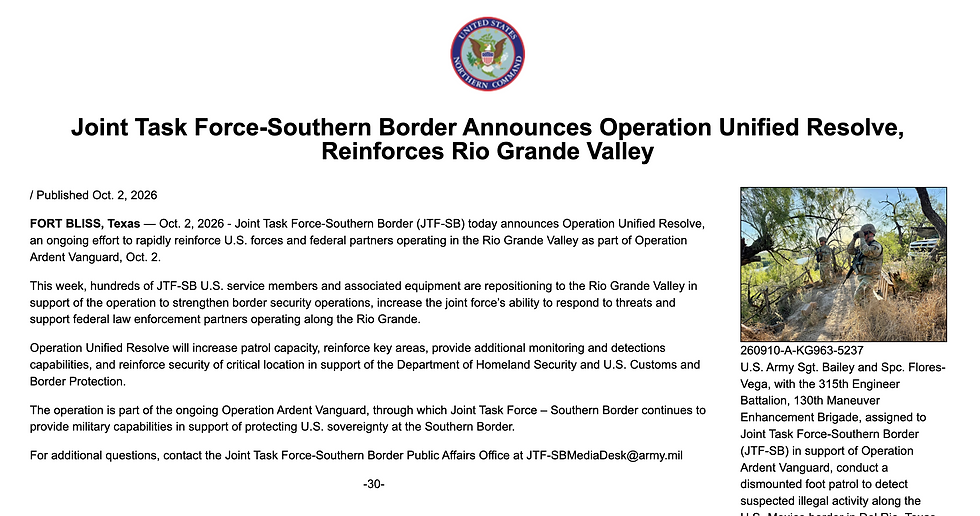
WHAT UNIFIED RESOLVE IS
JTF-SB announced Operation Unified Resolve on Oct. 2. U.S. Northern Command described it as an ongoing effort to rapidly reinforce U.S. forces and federal partners operating in the Rio Grande Valley.
It falls under Operation Ardent Vanguard, the military's name for its overall southern border mission. JTF-SB itself was activated in March 2025 to coordinate Defense Department operations along the border.
Northern Command said the operation is meant to increase patrol capacity, reinforce key areas, add monitoring and detection capability, and secure critical locations in support of the Department of Homeland Security and CBP.
Some national outlets, including Newsweek, reported the name as "Operation Unified Response." The military's own announcement uses "Unified Resolve."
THESE ARE NOT NEW TROOPS
The surge did not add soldiers to the border mission as a whole. It moved them.
Becky Farmer, a Northern Command spokesperson, told Border Report that troops were taken from other parts of the southern border and massed in the Valley. She described the operation as a "concentrated effort in the Rio Grande Valley."
HOW MANY
U.S. officials have said "hundreds." They have not publicly released an exact figure.
The only specific number so far comes from Mexico. Mexico's Navy and Foreign Ministry said about 500 U.S. service members were being deployed to the Valley. Mexico also said it is keeping 159 naval personnel, 11 vehicles and two drones on its side of the border through its naval sector in Matamoros.
U.S. officials told NewsNation they are working very closely with the Mexican military, and that Mexico surged resources to its side of the border after the Coast Guard came under fire.

WHAT PRECEDED IT
The surge followed a Sept. 26 incident on the river in Starr County.
A Coast Guard official told Border Report that Coast Guard Forces Rio Grande personnel encountered gunfire from the Mexican side near Garceño while conducting joint interdiction operations with federal partners. Coast Guard personnel returned fire. No injuries were reported.
The Coast Guard statement, as published, does not identify who fired. Several outlets have described the shooters as suspected cartel members. That attribution has not been publicly confirmed by the Coast Guard or DHS in the statements reviewed for this story.
The military's stated rationale is also broader than one incident. Farmer told Border Report the Coast Guard encounter was an example of illegal activity that tends to increase at this time of year. Other coverage of the task force's explanation points to a historically observed seasonal rise in attempted illegal activity.
THE AIRCRAFT
The most visible part of the surge is the CH-47 Chinook, the Army's twin-rotor heavy-lift helicopter.
On Oct. 17, JTF-SB posted video of soldiers deploying from a Chinook and unloading an Infantry Squad Vehicle in south Texas. The task force said the move supported expanded operational coverage in the Valley.
The capability was rehearsed before it arrived here. In July, soldiers with the 101st Airborne Division and the 1st Armored Division's aviation brigade, assigned to JTF-SB, practiced air insertion and extraction of troops and Infantry Squad Vehicles by Chinook near the Lechuguilla Desert and Marine Corps Air Station Yuma in Arizona, according to Defense Department photo records.

THE BOATS
The "riverine" part of the new post refers to Army boats, not Coast Guard boats. The distinction matters.
JTF-SB told NewsNation it is supplementing Border Patrol with 16 custom gator-tail boats built for this mission. The boats can operate in only inches of water.
Army boats on the river are not entirely new. Defense Department video shows soldiers assigned to JTF-SB operating M30 bridge erection boats in McAllen in January 2026. The task force has also described an initiative to put small autonomous unmanned surface vessels on the river for persistent monitoring.
The Coast Guard runs its own separate effort, Operation River Wall, which has expanded its boats and personnel along roughly 260 miles of the river since 2025. A Coast Guard official told Border Report the agency is not part of Unified Resolve but works closely with the military, Border Patrol and the Texas Military Department.
Raymond Jackson, identified by NewsNation as captain-commander of Force Rio Grande Valley, described the river mission as difficult. "Our mission is a challenging operation," Jackson told NewsNation. "We constantly deal with changing environments, and we deal with people that have all different backgrounds and so on and so forth. But our mission remains the same, and we continue to deal with and try to prevent personnel from coming across the border."
THE LASER AND THE DRONES
JTF-SB has posted images of soldiers maintaining a high-energy laser counter-drone system mounted on a tactical vehicle near Rio Grande City.
The task force told NewsNation it has taken down at least 16 cartel-linked drones with a high-energy laser since the system was deployed in late August. That figure comes from the military and has not been independently verified.
Border Patrol shares the concern. Joel Garcia, acting deputy chief patrol agent for the Rio Grande Valley Sector, told NewsNation that "drones are one of our greatest threats" from a national security standpoint.
Soldiers and agents are also flying their own drones, including Skydio models that can operate at night, according to NewsNation.
For residents, the drone fight has a direct consequence. Federal Aviation Administration restrictions now prohibit unauthorized drone flights within one nautical mile north of the U.S.-Mexico border. That affects hobbyists, farmers, photographers and journalists who fly near the river.
THE LAND
The military's footprint here is not only in the air and on the water.
The U.S. Section of the International Boundary and Water Commission temporarily transferred jurisdiction over federal property on and along about 250 miles of the Rio Grande in Cameron and Hidalgo counties, from the mouth of the river near South Padre Island to Roma, according to Northern Command. That stretch is now part of what the military calls the South Texas National Defense Area.

WHAT RESIDENTS ARE SAYING
Not everyone sees the helicopters as reassurance.
Edinburg resident Scott Nicol posted videos on Facebook of multiple Chinooks passing over his home, Border Report reported. In his posts, Nicol questioned the need for the flights, argued they waste fuel, and suggested they are meant to create an image of a border under invasion. Those are his opinions, and the military has not responded to them publicly.
HOW LONG IT LASTS
There is no announced end date.
JTF-SB told NewsNation it will remain in the Valley for a prolonged period until the operation is complete. The Coast Guard described its own river mission as enduring, with no end date.
SOURCES
U.S. Northern Command, Border Security page and Operation Unified Resolve announcement: https://www.northcom.mil/BorderSecurity/
National Guard, "Army aviation extends operational reach along the southern border" (Oct. 9, 2026 video): https://www.nationalguard.mil/Features/2025/Securing-the-Southern-Border/
Border Report (Sandra Sanchez), "Feds confirm surge in troops, Chinooks for border mission": https://www.wtnh.com/news/feds-confirm-surge-in-military-troops-chinook-helicopters-on-rio-grande-valley-border/
NewsNation (Ali Bradley), "Inside the surge hitting back at cartels with hundreds of US troops" (Oct. 28, 2026): https://www.newsnationnow.com/us-news/immigration/border-coverage/surge-hitting-cartels-hundreds-us-troops/
Newsweek, Operation "Unified Response" report: https://www.newsweek.com/us-troops-deployed-mexico-border-alleged-cartel-violence-12518278
STL News, Unified Resolve and Mexico's troop figures: https://www.stl.news/?p=661326
Joint Task Force-Southern Border on X: https://x.com/JointTFSB
DVIDS, JTF-SB air insertion and extraction training, July 2026: https://www.dvidshub.net/image/9818451/jtf-sb-soldiers-conduct-air-extraction-operations
DVIDS, JTF-SB unit page (M30 boats in McAllen, Jan. 2026): https://www.dvidshub.net/unit/DOWSB/?page=2
DVIDS, JTF-SB deploys unmanned surface vessels: https://www.dvidshub.net/news/559376/joint-task-force-southern-border-deploys-cutting-edge-tech-transforming-border-operations
Army.mil, 1st Combat Aviation Brigade assumes JTF-SB aviation operations: https://www.army.mil/article/285654/1st_combat_aviation_brigade_assumes_aviation_operations_for_joint_task_force_southern_border
Comments